


Pimcore vs. Inriver - Find the Best PIM Platform for Your Company
Product information management has become essential for companies managing growing catalogs, multiple sales channels, regional requirements, and complex customer expectations. A reliable PIM platform centralizes product data, improves quality, accelerates enrichment, and distributes accurate information across eCommerce sites, marketplaces, print catalogs, distributor portals, and other touchpoints.
Pimcore and Inriver are two established platforms considered by manufacturers, retailers, distributors, and consumer brands. However, they approach product data differently.
Pimcore is a broader open-core data and experience management platform that combines PIM with master data management, digital asset management, digital experience management, portals, syndication, and commerce capabilities. Inriver is a multi-tenant SaaS PIM focused on the complete product content lifecycle, from onboarding and enrichment to syndication and digital shelf optimization.
This Pimcore vs Inriver comparison covers their features, benefits, pricing approaches, implementation considerations, and ideal use cases.
Pimcore vs Inriver: Quick Verdict
Pimcore is a stronger fit for organizations that need flexible data modeling, multi-domain data management, native DAM or DXP capabilities, custom workflows, and greater control over deployment. Inriver is a strong option for organizations that want a managed SaaS PIM focused on product onboarding, enrichment, syndication, channel compliance, and digital shelf performance.
Neither platform is universally better. The right choice depends on data complexity, internal technical resources, channel strategy, implementation timeline, and the long-term digital roadmap.
A Brief About Pimcore
Pimcore is an open-core platform designed to manage structured data, unstructured content, digital assets, and digital experiences within one architecture. Its capabilities include Product Information Management, Master Data Management, Digital Asset Management, DXP and CMS functionality, experience portals, data syndication, customer data capabilities, and a digital commerce framework.
Organizations can use individual capabilities or combine them into a broader data and experience ecosystem. This makes Pimcore relevant for businesses that need to manage more than product attributes and descriptions.
Pimcore supports on-premises, private-cloud, and managed PaaS deployment. Its 2026.1 release also made Pimcore Studio the primary modern administration interface. The platform is highly customizable, but that flexibility usually requires thoughtful architecture, implementation expertise, and ongoing technical ownership.
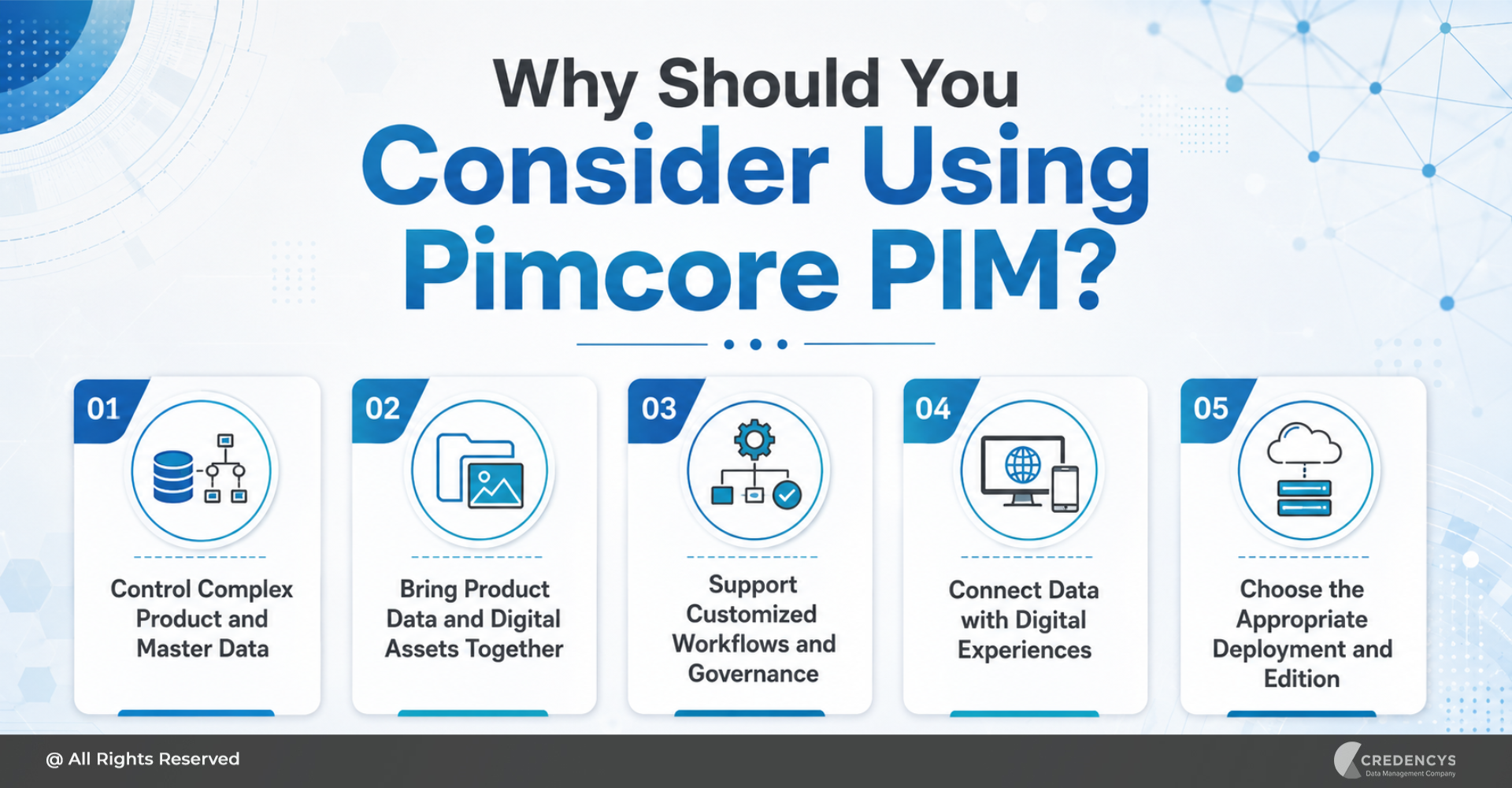
Why Should You Consider Using Pimcore PIM?
Control Complex Product and Master Data
Pimcore manages complex products, variants, categories, relationships, technical specifications, localized content, and product hierarchies. Its flexible data model is useful when standard PIM templates cannot represent how a business structures its products.
Organizations can also manage related master data, including suppliers, materials, locations, customers, and dealers, thereby reducing the need for disconnected systems across data domains.
Bring Product Data and Digital Assets Together
Pimcore combines PIM and DAM capabilities, enabling teams to connect products with images, videos, manuals, certificates, technical documents, and marketing materials. This native relationship can reduce asset-searching time, prevent incorrect files from reaching channels, and improve consistency across digital and offline experiences.
Support Customized Workflows and Governance
Organizations can configure roles, permissions, approvals, validation rules, enrichment stages, and publishing requirements. This supports processes involving engineering, product management, legal, localization, marketing, and eCommerce teams.
Connect Data with Digital Experiences
Pimcore supports websites, portals, content experiences, commerce use cases, and headless delivery. Product information can power brand sites, dealer portals, marketplaces, mobile applications, and other channels.
Choose the Appropriate Deployment and Edition
Pimcore provides Community, Professional, Enterprise, and PaaS options. Businesses should compare the available Pimcore editions based on their licensing, hosting, support, scalability, and implementation requirements.
A Brief About Inriver
Inriver is an enterprise PIM delivered through a multi-tenant SaaS model. It manages the product content lifecycle across four broad stages: ingest, enrich, syndicate, and optimize.
The platform consolidates information from ERP, PLM, suppliers, and other systems. Teams can structure, validate, enrich, localize, approve, and distribute product content to retailers, distributors, marketplaces, and eCommerce platforms.
Inriver emphasizes product data governance, workflow orchestration, syndication, channel readiness, and post-publication performance. Its current portfolio includes Content Onboarding, Inspire AI, Syndicate Advance, Digital Shelf Analytics, Brand Store, and Print & Publish.
Because Inriver is a managed SaaS, customers do not maintain the underlying application infrastructure. This simplifies upgrades and maintenance, although organizations operate within the architecture and extensibility options provided by the vendor.
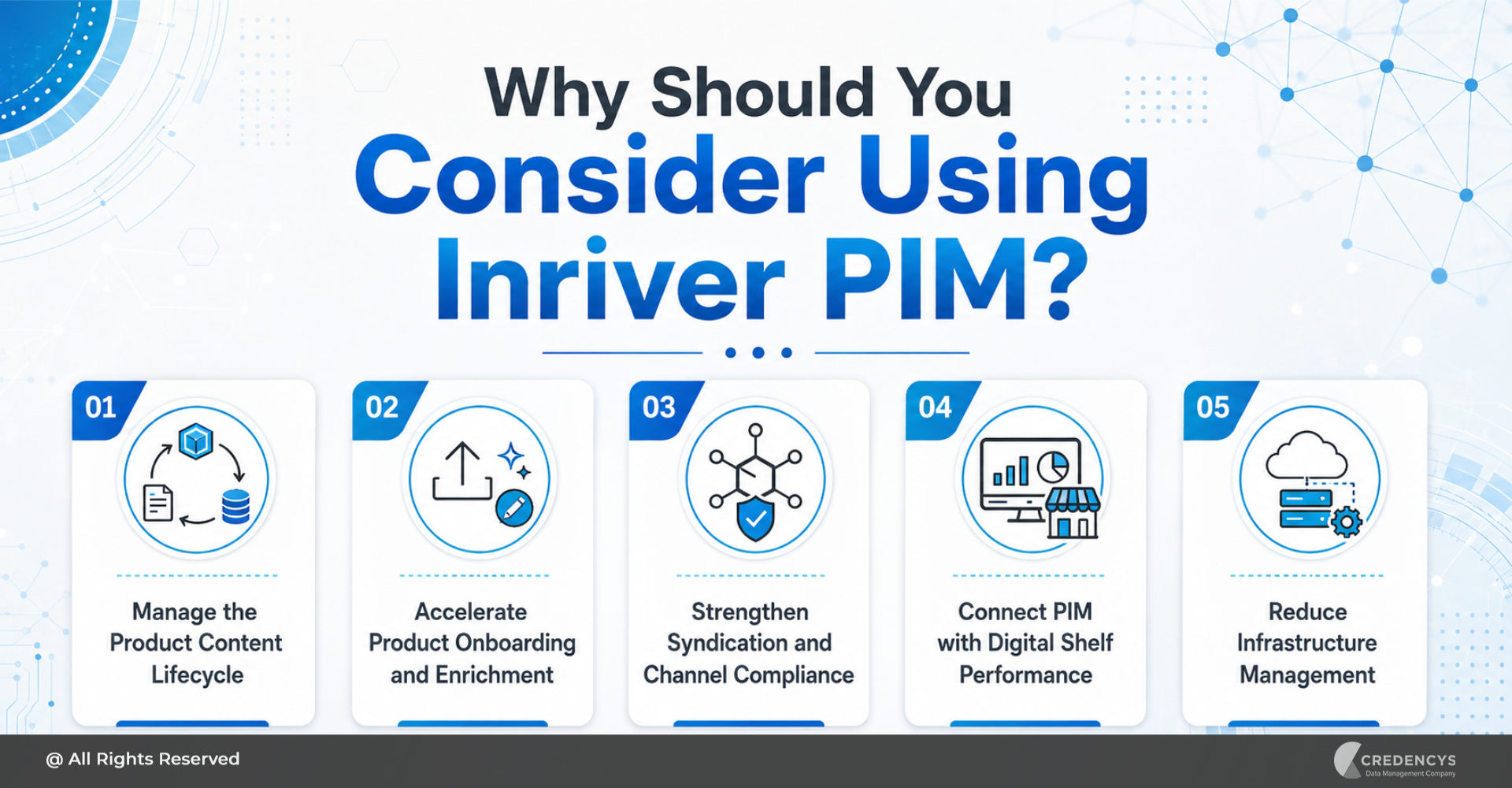
Why Should You Consider Using Inriver PIM?
Manage the Product Content Lifecycle
Inriver connects onboarding, enrichment, validation, syndication, and optimization. This helps teams replace fragmented spreadsheets, emails, shared drives, and manual channel uploads.
Its elastic data model supports relationships between products, parts, attributes, channels, and related entities.
Accelerate Product Onboarding and Enrichment
The platform consolidates information received from suppliers and enterprise systems. AI-assisted capabilities help map, structure, identify gaps, enrich, and localize product content.
This is useful for manufacturers and distributors who handle large supplier files or expand assortments across markets.
Strengthen Syndication and Channel Compliance
Inriver helps map product information to the requirements of retailers, marketplaces, distributors, and commerce platforms. A structured product data syndication process helps distribute standardized product descriptions, attributes, images, and other channel-ready information across digital destinations.
Validation and governance can identify incomplete or noncompliant data before publication, reducing the number of rejected listings and the need for correction work.
Connect PIM with Digital Shelf Performance
Digital Shelf Analytics shows how product content appears and performs across online channels. Teams can identify missing information, inconsistent listings, compliance issues, and content-performance gaps.
Reduce Infrastructure Management
The multi-tenant SaaS model provides vendor-led updates and maintenance. It suits businesses that prefer managed cloud operations to maintaining PIM infrastructure internally.
Pimcore vs Inriver – Things You Need to Know
Both platforms manage enterprise product information, but their scope and operating models differ.
1. Pimcore vs Inriver: Features Comparison
Common Capabilities
Pimcore and Inriver both support:
- Centralized product information
- Product hierarchies and relationships
- Data import and integration
- Enrichment and localization
- Validation and quality controls
- Workflow and approvals
- Multi-channel distribution
- Roles and permissions
- Digital asset association
- APIs and integrations
The main difference lies in how broadly they extend beyond PIM and in how their capabilities are delivered.
Pimcore Features
Pimcore offers:
- Flexible product and multi-domain data modeling
- Native PIM, MDM, DAM, and DXP capabilities
- Product and asset experience portals
- Data syndication and feed management
- Headless delivery
- CMS and website capabilities
- Digital commerce framework
- Multiple deployment models
- Extensive development-level customization
Pimcore is valuable when product information must work closely with digital assets, master data, websites, portals, or custom applications.
Inriver Features
Inriver offers:
- Product content onboarding
- Elastic product data modeling
- AI-assisted enrichment and localization
- Data validation and governance
- Workflow orchestration
- Syndicate Advance
- Digital Shelf Analytics
- Brand Store
- Print and Publish
- Product relationships and bundling
- SaaS-based operations
Inriver is strong when the primary objective is improving product content operations, syndication, compliance, and digital shelf performance.
2. Pimcore vs Inriver: Benefits Comparison
Pimcore Benefits
Pimcore provides broad architectural flexibility. Organizations can shape data models and processes around their business rather than forcing requirements into a predefined structure.
However, a successful Pimcore implementation requires clear data modeling, integration planning, governance, testing, user adoption, and long-term technical ownership.
Inriver Benefits
Inriver provides a focused SaaS environment for product content teams. Its capabilities in onboarding, enrichment, syndication, and optimization align with the work of manufacturers, brands, and distributors.
The managed model reduces infrastructure responsibilities and provides a standardized upgrade path. Its syndication and Digital Shelf Analytics capabilities are valuable for organizations selling through many retailers and marketplaces.
Businesses requiring native CMS, advanced DAM, multi-domain MDM, or highly customized applications may need additional systems and integrations.
3. Pimcore vs Inriver: Price and Cost Comparison
Pimcore Pricing and Cost
As of June 2026, Pimcore lists Professional Edition at $9,900 per year and Enterprise Edition at $29,900 per year. Its managed PaaS offering starts at $39,900 per year.
Infrastructure, implementation, customization, migration, integrations, training, and support should also be included in total cost. Community Edition is not automatically a free production option for every organization.
Under the current open-core licensing model, eligibility depends on the type and scale of use. Larger commercial production deployments generally require a commercial edition.
Pimcore can offer favorable long-term economics when organizations combine several capabilities. However, heavy customization may require greater initial technical investment.
Inriver Pricing and Cost
Inriver does not publish fixed subscription prices. It offers customizable Foundation, Core, Professional, and Enterprise plans for organizations at varying scales.
The final cost may depend on the plan, users, modules, product volumes, integrations, syndication requirements, implementation services, and support. Businesses should compare three- to five-year total cost, including migration, integration, change management, internal staffing, channel onboarding, and ongoing administration.
4. Pimcore vs Inriver: Why and When to Use?
When to Use Pimcore
Pimcore may be the better choice when:
- Product and master data structures are highly complex
- The organization needs PIM, DAM, MDM, DXP, or portals in one architecture
- Custom workflows and applications are strategic
- The business requires deployment flexibility
- Internal teams or a partner can support technical ownership
- Product data must power customized websites, portals, and commerce experiences
When to Use Inriver
Inriver may be the better choice when:
- The organization wants a managed multi-tenant SaaS PIM
- Product onboarding and enrichment are central priorities
- The business distributes content to many retailers or marketplaces
- Channel compliance and syndication are critical
- Digital shelf monitoring is important
- The company prefers a specialized PIM connected to its existing ecosystem
5. Pimcore vs Inriver: Who Wins?
There is no clear winner in the Pimcore vs. Inriver comparison. Pimcore has an advantage when an organization needs a configurable platform combining complex data management with assets, content, portals, and digital experiences.
It suits companies willing to invest in tailored architecture and technical ownership. Inriver has an advantage when an organization wants specialized SaaS PIM with strong onboarding, syndication, governance, AI-assisted workflows, and digital shelf feedback.
It suits product-driven businesses that want to improve content operations without having to manage the underlying infrastructure. The best choice depends on use cases, data complexity, existing systems, channel strategy, skills, governance maturity, and total cost.
Pimcore vs Inriver: A Tabular Comparison
| Key Aspect | Pimcore | Inriver |
|---|---|---|
| Platform Focus | Broad data and experience management platform combining PIM, MDM, DAM, DXP, portals, syndication, and commerce capabilities | Specialized product information management platform focused on product content onboarding, enrichment, syndication, and optimization |
| Architecture | Open-core and highly extensible architecture | Managed multi-tenant SaaS architecture |
| Deployment | Supports on-premises, private cloud, and managed PaaS deployment | Delivered as a vendor-managed cloud SaaS platform |
| Data Modeling | Highly flexible product and multi-domain data models for complex business requirements | Elastic product-focused data model supporting products, attributes, relationships, and channels |
| Master Data Management | Provides native multi-domain MDM for product, customer, supplier, asset, location, and other data domains | Primarily focused on product-related information and connected product entities |
| Digital Asset Management | Provides native DAM capabilities for images, videos, documents, certificates, and other digital assets | Supports multimedia management and integrations with external DAM platforms |
| CMS and DXP | Provides native CMS and digital experience management capabilities | Usually integrates with external CMS and DXP platforms |
| Product Onboarding | Supports configurable imports, APIs, integrations, validation, and custom onboarding workflows | Provides dedicated product content onboarding capabilities for consolidating supplier and enterprise data |
| Product Enrichment | Supports configurable enrichment workflows, localization, validation, and completeness rules | Provides structured enrichment, localization, governance, and AI-assisted content operations |
| Product Data Syndication | Supports feeds, APIs, marketplace integrations, and customized channel delivery | Places strong emphasis on channel syndication through Syndicate Advance |
| Digital Shelf Analytics | May require additional configuration, integrations, or third-party solutions | Provides dedicated Digital Shelf Analytics capabilities for monitoring online product content and performance |
| AI Capabilities | Supports Pimcore Copilot and extensible AI use cases across data, assets, and digital experiences | Provides Inspire AI for product content mapping, enrichment, localization, and optimization |
| Workflow and Governance | Offers highly configurable workflows, roles, permissions, approval processes, and validation rules | Provides product-focused workflow orchestration, governance, validation, and channel-compliance controls |
| Commerce Capabilities | Provides a Digital Commerce Framework in eligible editions and supports customized commerce experiences | Integrates with external eCommerce and marketplace platforms |
| Customization | Supports extensive development-level customization and tailored applications | Supports configuration and extensions within the SaaS platform and available integration framework |
| Infrastructure Management | Infrastructure responsibilities depend on whether the platform is deployed on-premises, in a private cloud, or through PaaS | Infrastructure, platform upgrades, and core maintenance are primarily managed by Inriver |
| Pricing Approach | Offers Community, Professional, Enterprise, and PaaS options, with additional implementation and infrastructure costs | Offers customizable Foundation, Core, Professional, and Enterprise plans with quote-based pricing |
| Technical Resources | Typically requires stronger technical involvement for architecture, customization, integration, and maintenance | Reduces infrastructure responsibilities but still requires expertise in data modeling, integrations, governance, and adoption |
| Best Suited For | Organizations requiring complex data models and an integrated PIM, MDM, DAM, DXP, portal, and commerce ecosystem | Organizations prioritizing SaaS-based product content operations, syndication, channel compliance, and digital shelf optimization |
Conclusion
Pimcore and Inriver are capable enterprise PIM platforms, but they support different technologies and operating strategies. Pimcore is strong for organizations that need flexible product and master data connected with DAM, DXP, portals, syndication, and customized digital solutions.
Inriver is strong for organizations seeking managed SaaS PIM centered on onboarding, enrichment, governance, syndication, and digital shelf optimization. Before selecting either platform, assess your data model, integrations, sales channels, user groups, governance, deployment preferences, implementation resources, and three- to five-year total cost.
A structured discovery and proof of concept can confirm which platform fits current priorities and future growth.
Frequently Asked Questions
What Is the Main Difference Between Pimcore and Inriver?
Pimcore combines PIM with MDM, DAM, DXP, portals, syndication, and commerce capabilities. Inriver is a specialized SaaS PIM focused on onboarding, enrichment, governance, syndication, and optimization.
Is Pimcore or Inriver Better for Manufacturers?
Both support manufacturers. Pimcore may suit complex product, parts, supplier, asset, and master data requirements. Inriver may suit manufacturers prioritizing supplier onboarding, enrichment, retailer syndication, and channel compliance.
Which Platform Offers Stronger Syndication Capabilities?
Inriver places syndication at the center of its strategy and connects it with Digital Shelf Analytics. Pimcore also supports syndication, feeds, APIs, and marketplace integrations, with greater flexibility for customized delivery.
Is Pimcore Still Open Source?
Pimcore describes its current model as open core. Current versions use the Pimcore Open Core License. Community Edition eligibility is limited by defined conditions, while commercial production use may require Professional or Enterprise licensing.
Which Platform Requires More Technical Resources?
Pimcore typically requires more technical involvement when organizations use its customization and broader architecture. Inriver reduces infrastructure responsibility through SaaS, although modeling, integrations, governance, and change management still require skilled resources.
Pimcore vs. Competitors
Do you want to understand how Pimcore stands out from its competitors?
Here are some detailed comparisons of Pimcore with other technology platforms to help you pick the right platform that supports your consistent business growth and success.






Tags: